 Makerdao
 vaults connect Dai borrowing to locked collateral and debt limits
Updated
Makerdao vaults let owners draw Dai when their locked collateral supports the resulting debt and the protocol permits additional borrowing. Each position has its own collateral balance and debt, while shared settings constrain its collateral type. Accrued stability fees can increase the repayment amount over time. Withdrawals must preserve backing for any remaining debt. The project adopted the Sky name in 2024, and active governance now uses SKY.
Collateral value sets the boundary for a Dai draw
Additional locked collateral increases the debt that a Vault can support under its current risk settings, while debt ceilings can block further borrowing. A collateral deposit and a debt increase change different records, even when an interface combines them within one transaction. An adapter deposit credits available collateral in the Vat; locking it into the Vault changes the backing recorded as
ink
. Deposited tokens alone therefore don’t establish either borrowing capacity or an outstanding loan.
Locked collateral and normalized debt
The Vat stores each Vault as an
urn
, with
ink
for locked collateral and
art
for normalized debt. Normalized debt records the obligation before applying its accumulated fee multiplier. An
ilk
identifies the collateral type associated with that position. Borrowing changes
art
; adding or releasing locked collateral changes
ink
. The
frob
operation can adjust both together, subject to the applicable checks. Different collateral types can also apply different risk settings to the same underlying asset.
The price that the protocol uses
Borrowing checks compare debt after the proposed change with
ink × spot
, the collateral’s safety-adjusted Dai capacity. That capacity reflects the protocol’s price and risk settings. A wallet’s market-price display needn’t match that value. Collateral paths that use the Oracle Security Module introduce a delayed price feed, whose update schedule affects downstream contracts. Successful
poke()
calls advance that feed’s recorded values only when the source reports a valid price. A falling price can shrink headroom even when the deposited token amount hasn’t changed.
A Vault identifier connects ownership to the Vat
The CDP Manager maps a numeric Vault identifier to its owner, collateral type and underlying
urn
address. An owner can manage multiple positions through that contract. Collateral adapters hold deposited tokens and connect them to the Vat’s balances. DaiJoin converts internal Dai into transferable ERC-20 Dai for a wallet. Position ownership, deposited collateral and token delivery therefore involve different contracts. An interface can combine their calls without changing those responsibilities.
What can block a draw when the collateral ratio is sufficient?
Collateral-type and system debt ceilings can block a draw even when the Vault meets its collateral requirement. The Vat applies those ceilings to debt increases, alongside a minimum debt rule for individual positions. An initialized collateral type, a live protocol and the required permissions also matter. These tests apply to the proposed new state, so the starting collateral ratio can’t establish that an adjustment will succeed.
The Vat exposes collateral-specific values through
ilks(ilk)
and the global ceiling through
Line()
. Governance, price updates and fee accrual affect different fields.
| Vat parameter | Value and scope | Effect on a Vault adjustment |
|---|---|---|
spot
|
Current safety-adjusted Dai capacity per collateral unit, in the selected
ilks(ilk)
record.
|
A decline reduces the debt that the same locked collateral supports. |
line
|
Configured aggregate debt ceiling for the selected collateral type, in
ilks(ilk)
.
|
Adding collateral doesn’t overcome exhausted borrowing capacity for that type. |
Line
|
Configured maximum total system debt, returned by
Line()
.
|
New debt also needs room under the system ceiling. |
dust
|
Configured minimum nonzero debt per Vault, in the selected
ilks(ilk)
record.
|
A repayment must leave qualifying debt or clear the debt. |
rate
|
Accumulated debt multiplier for the selected collateral type, in
ilks(ilk)
.
|
An increase raises repayment requirements without a new draw. |
A ceiling constrains aggregate debt within its scope, so owners share available headroom with other positions that use that capacity. Repayments can create room, and governance can change the ceiling. Accrued fees can still increase existing debt beyond a ceiling; the ceiling restricts fresh borrowing without capping the obligation already outstanding.
Other positions can consume debt-ceiling headroom between a borrowing estimate and transaction execution. Price and fee updates can change the position’s own capacity during that interval. The Vat evaluates the actual execution state, so an earlier estimate doesn’t establish a permitted draw.
A reverted Vat adjustment doesn’t commit its proposed balances. A deposit completed in an earlier transaction remains separate from a later failed draw.
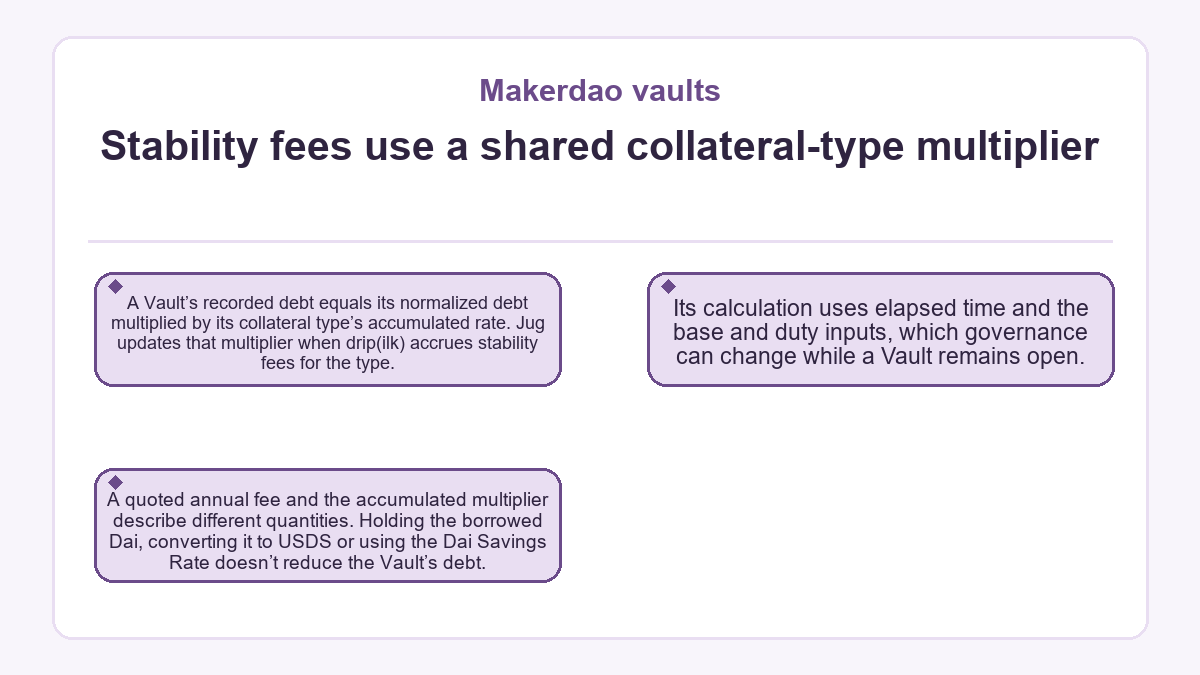
Stability fees use a shared collateral-type multiplier
A Vault’s recorded debt equals its normalized debt multiplied by its collateral type’s accumulated rate.
Jug updates that multiplier when
drip(ilk)
accrues stability fees for the type. Its calculation uses elapsed time and the
base
and
duty
inputs, which governance can change while a Vault remains open. A quoted annual fee and the accumulated multiplier describe different quantities. Holding the borrowed Dai, converting it to USDS or using the
Dai Savings Rate
doesn’t reduce the Vault’s debt.
Can an owner withdraw collateral before repaying all Dai debt?
An owner can withdraw some collateral before full repayment if the remaining collateral supports the remaining debt. The Vat checks the position after the proposed withdrawal, using its applicable price and risk settings.
Partial repayment and the debt floor
Reducing debt generally increases the collateral that the position can release. The
dust
rule still constrains the remainder: an ordinary partial repayment can’t leave nonzero debt below the applicable floor. It must leave a qualifying balance or clear the debt. The safety check also permits debt reduction without collateral withdrawal when the position remains undercollateralized, subject to other checks. That exception allows an adjustment that reduces risk; it doesn’t authorize withdrawing backing from an unsafe position.
Full repayment and collateral release
Clearing the debt requires an amount that includes accrued stability fees and removes the debt constraint on remaining collateral. The original draw amount excludes those subsequent fees. Unlocking collateral within the Vat and returning external tokens through an adapter are distinct operations, which an interface may combine. A lower
ink
balance records released backing; the wallet’s token balance records external delivery. These descriptions assume ordinary operation before liquidation or Emergency Shutdown changes the applicable process.
Liquidation and specialized Vaults follow different recovery rules
An insufficiently collateralized crypto Vault using Liquidation 2.0 can enter a
Clipper
auction through the
Dog
liquidation module. The sale target covers debt, accrued stability fees and the liquidation penalty. Dutch-auction purchases settle immediately at the applicable auction price. Once sufficient Dai covers the collection target, unsold collateral returns to the liquidated Vault’s urn as unlocked collateral in the Vat. That remainder is a collateral amount, not a promise to refund the original deposit or its market value.
Liquidation 2.0 normally targets the Vault’s full debt, but global and collateral-specific active-auction limits can force partial liquidation. Those limits constrain debt plus penalties assigned to active auctions. Available room can change how much of an unsafe position enters an auction at once. It doesn’t erase the rest of the debt or establish a grace period. Collateral already in an auction no longer follows the Vault’s ordinary withdrawal calculation.
The SKY Staking Engine uses SKY collateral for USDS borrowing and doesn’t permit transfers of its positions. The CDP Manager’s ownership-transfer mechanism applies to a different type of Vault.
The MIP21 real-world-asset Vault design relies on governance-approved counterparties and legal agreements. Its collateral recovery uses manual off-chain processes that can take months or years.
Makerdao vaults questions, answered
Do I need MKR or SKY to open a Dai collateral Vault?
Owning MKR or SKY isn’t a general prerequisite for opening a standard Dai collateral Vault. Governance-token ownership and authorization to manage a borrowing position are separate matters. The collateral type must be accepted, the position must meet its debt and collateral rules and transaction execution needs Ethereum gas. A SKY-backed Staking Engine position has a different starting requirement because that design uses SKY as collateral.
Can a CDP Manager Vault change owners while debt remains?
A CDP Manager Vault can change owners without first clearing its debt. The Manager’s give operation transfers control of the identified position, which retains its collateral and debt records. The new owner controls that position; the transfer doesn’t repay the loan or release its locked backing. Native Vat fork operations use separate authorization and safety checks, so they aren’t interchangeable with the Manager’s ownership transfer.
What causes newly drawn Dai to remain at a Vault’s urn address?
The CDP Manager’s frob variant without a destination leaves newly created internal Dai at the Vault’s urn address. That balance exists inside the Vat and hasn’t necessarily become ERC-20 Dai in a wallet. The Manager’s move operation transfers internal Dai, while DaiJoin handles conversion into external tokens. An interface may combine these operations, so internal creation and wallet delivery needn’t require separate user transactions.
Is repayment tied to the Dai tokens originally generated by the Vault?
A Vault repayment can use Dai obtained elsewhere; it isn’t tied to the tokens that the Vault originally generated. Repayment needs sufficient Dai value in the applicable repayment path and an adjustment to the correct position’s debt. Buying Dai doesn’t repay a Vault by itself. Dai’s market price can affect the external cost of acquiring repayment tokens, and accrued stability fees remain part of the amount that the borrower owes.
Are a Dai Vault’s collateral and debt balances private?
A Dai Vault’s on-chain collateral and debt records are publicly inspectable. The CDP Manager exposes ownership and position mappings, while the Vat exposes the underlying balances. These records associate positions with blockchain addresses. They don’t automatically identify an address owner’s legal name, although ownership mappings make relationships between addresses and Vaults visible. Switching interfaces doesn’t conceal the records that the same contracts maintain.
When can a Liquidation 2.0 collateral auction require a price reset?
A Liquidation 2.0 auction can require a reset after its configured time limit or price-decrease threshold is reached. The tail and cusp parameters govern those conditions. A reset restarts the auction clock and recalculates its starting price from the applicable oracle value and buffer. That price can exceed the price before the reset. A purchaser’s maximum acceptable price constrains a take operation when the auction price changes.